Healthy-looking hair starts below the skin.
Humans have about 5 million hair follicles, around 100,000 of them on the scalp. Hair shapes how we look, but it also helps regulate body temperature and protects the skin from sun, friction and debris.
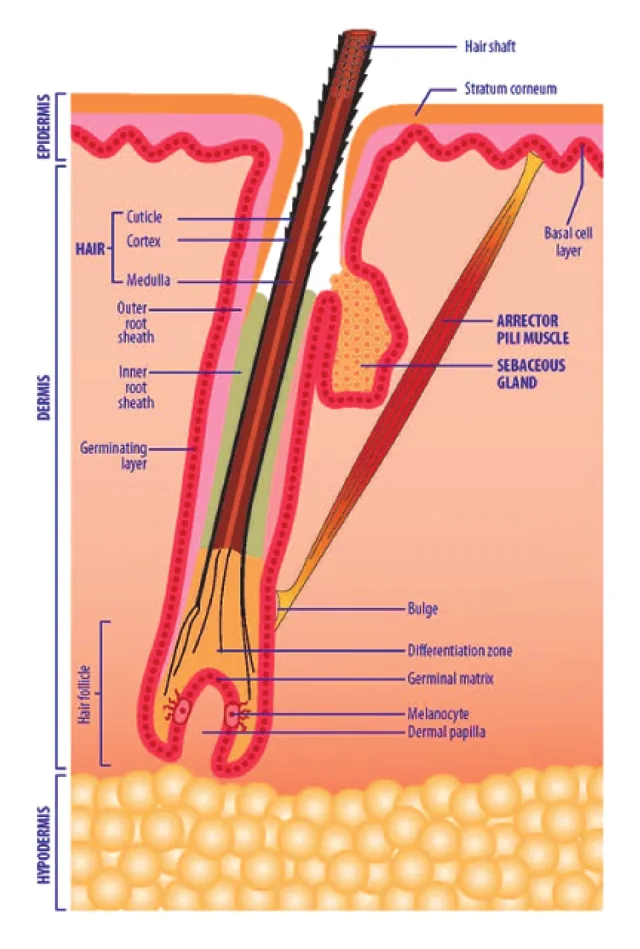
Where every strand is made.
The follicle is the living part of hair. It is a small pocket of skin that reaches down through the dermis, the skin's middle layer.
- Hair bulbThe rounded base of the follicle. Fast-dividing cells in the bulb, called the matrix, build the new hair.
- Dermal papillaA cluster of specialised cells at the bottom of the bulb, fed by tiny blood vessels. It sends the signals that start and sustain hair growth.
- MelanocytesPigment cells in the bulb. They pass melanin into the growing hair, which gives it its colour.
- BulgeAn area higher up the follicle that stores stem cells, so the follicle can regrow hair after each shedding cycle.
- Sebaceous glandA small oil gland attached to the follicle. Its sebum coats the scalp and strand and helps keep them soft.
- Arrector pili muscleA tiny muscle that makes hair stand up, causing goosebumps.
The part you see is made of keratin.
The shaft contains no living cells. That is why damaged strands can be protected and smoothed, but not truly repaired.
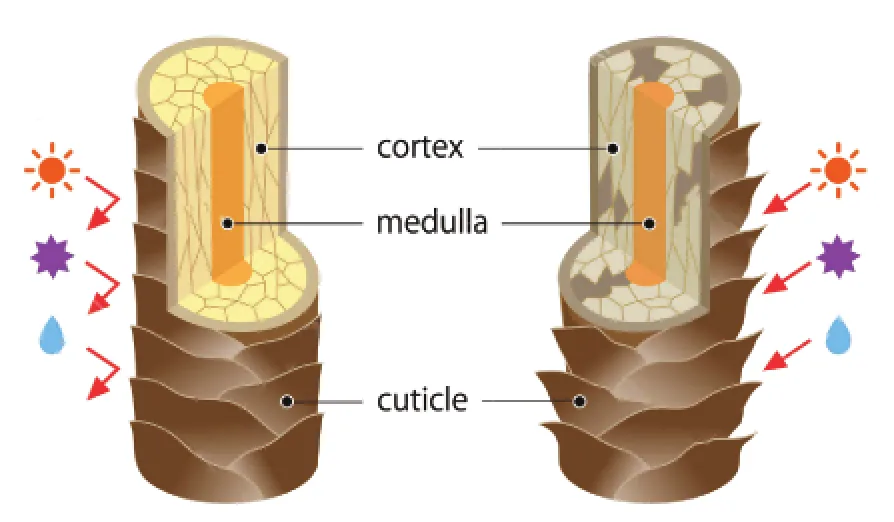
Medulla
The soft inner core. It is often absent in fine hair, and its exact role is still not well understood.
Cortex
The thick middle layer and most of the hair's mass. It gives strength, elasticity and texture, and holds the melanin that creates natural colour.
Cuticle
Thin, overlapping scales, like roof tiles. When they lie flat, they protect the cortex, reflect light for shine and help hair repel water.
Bonds inside the cortex
Three types of bond hold the cortex's keratin together, and they explain how styling works.
| Bond | Strength | What breaks it |
|---|---|---|
| Hydrogen bonds | Weak | Water and heat. This is why blow-drying, curling and straightening hold only until the next wash or humid day. |
| Salt bonds | Weak | Changes in pH. They re-form once the pH returns to normal. |
| Disulfide bonds | Strong | Chemical services such as perms, relaxers and chemical straightening. Bleaching also damages them, which is why bleached hair becomes weaker. |
Every follicle runs on its own clock.
Scalp hair grows about 0.3 to 0.4 mm a day, roughly 1 cm a month. Losing around 50 to 100 hairs a day is normal.
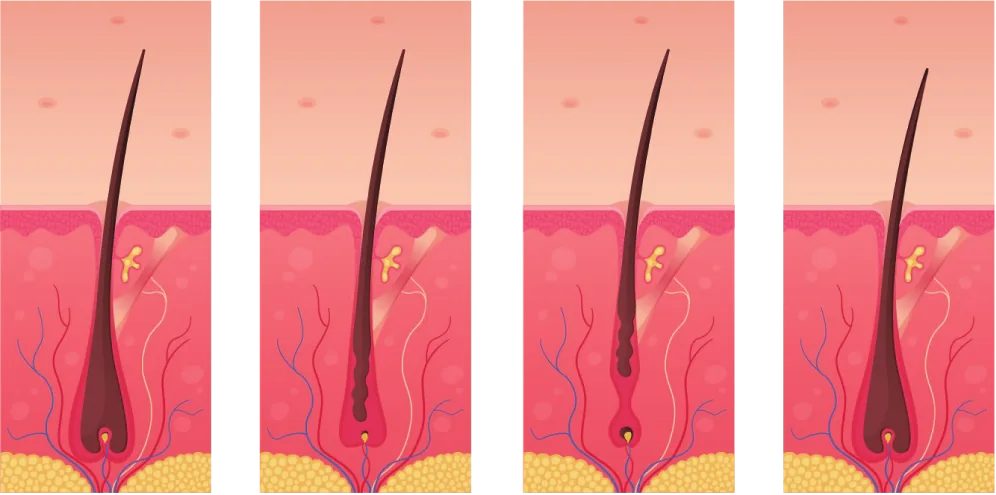
Anagen
Growth, 2 to 7 years. The follicle actively builds hair; this phase decides how long your hair can grow. About 85 to 90% of scalp hairs are here.
Catagen
Transition, 2 to 3 weeks. Growth stops and the lower follicle shrinks. The hair becomes a "club hair", no longer fed but still anchored.
Telogen
Rest, about 3 months. The follicle rests while the club hair stays in place. About 10 to 15% of scalp hairs are resting.
Exogen
Shedding. The old hair is released, often pushed out by a new hair starting anagen. Then the cycle begins again.
Know your hair, choose better care.
Hair is usually described by four traits: texture, density, colour and curl pattern.
Texture
The thickness of each strand. Fine hair is the thinnest and can be weighed down easily. Medium is the most common. Coarse is the thickest; usually strong, but can feel dry.
Density
How many strands grow on your scalp, described as low, medium or high. It is about number, not thickness: you can have fine hair at high density.
Colour
Two types of melanin in the cortex. Eumelanin gives brown and black shades; pheomelanin gives red and yellow tones. Grey appears when melanocytes make less melanin.
Curl pattern
The shape of the follicle and the strand's cross-section largely decide how hair curls.
| Type | Pattern | Follicle and strand shape |
|---|---|---|
| 1 | Straight | Follicle is fairly straight; strand is round to slightly oval |
| 2 | Wavy | Follicle is slightly curved; strand is more oval |
| 3 | Curly | Follicle is more curved; strand is flatter and elliptical |
| 4 | Coily | Follicle is the most curved; strand is the flattest |
A healthy scalp is the base.
Scalp skin has the same layers as the skin on your face, but more follicles and oil glands. It also hosts a microbiome of bacteria and yeasts that, in balance, helps protect the skin.
| Concern | What is happening | Common signs |
|---|---|---|
| Dry scalp and hair | Too little sebum reaches the scalp and strands, or moisture is lost to harsh washing, heat or weather. | Tightness, fine flakes, dull or rough hair |
| Dandruff | Mainly linked to overgrowth of Malassezia, a yeast that lives on everyone's scalp, and how sensitive each person's skin is to it. | Itching and white or yellowish flakes |
| Oily scalp | Oil glands produce more sebum than usual, often because of genetics, hormones, stress or climate. | Hair looks greasy soon after washing |
| Cuticle damage | Heat, chemical services, sun and rough handling lift or wear away the cuticle scales. | Frizz, tangles, dullness, split ends and breakage |
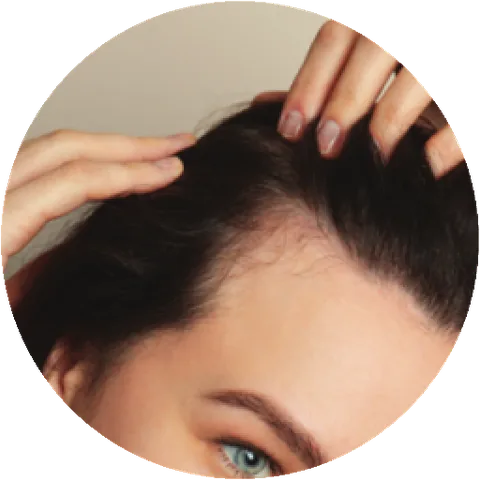
Ongoing itching, redness, sudden shedding or bald patches can signal a medical condition. In those cases, see a doctor or dermatologist.
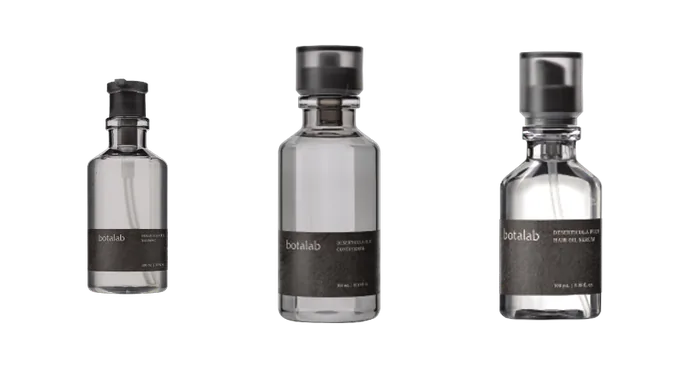
The botalab Deserticola Plus line.
Its key ingredient, Deserticola Plus, is a microalga from desert environments, developed by Dr. Heesik Kim of the Korea Research Institute of Bioscience and Biotechnology with RIMAN's ASK Labs.
The research focused on raising the level of loliolide, a natural compound with antioxidant properties; RIMAN reports 12 times the concentration found in traditional algae sources. The formulas also include chlorella oil and wild olive stem cell extract. The line is certified vegan by V-Label.
Shampoo
Cleanses the scalp and hair without stripping natural oils, leaving hair looking fuller and balanced.
Conditioner
Smooths and conditions the cuticle for shine and softer, stronger-feeling hair. It thickens on contact with water and gives a gentle warming feel.
Hair Oil Serum
A lightweight 5-in-1 finishing serum with five botanical oils, for damp, air-dried or styled hair, without feeling heavy or greasy.
These products are cosmetics. They are not intended to diagnose, treat or prevent hair loss or any scalp condition.